How to Choose a Water Chiller Evaporator?
Choosing a Water Chiller Evaporator is not a simple capacity-matching exercise. It affects efficiency, stability, maintenance, and operating cost. The wrong choice may appear acceptable during commissioning. Problems often emerge later, during humid afternoons, fouled tubes, or partial-load operation.
The International Energy Agency reports that space-cooling demand could more than triple by 2050 without stronger efficiency measures. UNEP’s 2023 Global Cooling Watch also highlights rapidly growing cooling demand and the need for efficient equipment. These findings make evaporator selection increasingly important. A practical review should examine cooling load, refrigerant compatibility, chilled-water temperature, pressure drop, approach temperature, fouling risk, and part-load performance. ASHRAE guidance also emphasizes evaluating chillers as complete systems, not isolated components.
Professor Moncef Krarti, a recognized HVAC efficiency researcher, states, “Energy efficiency is the first fuel.” That principle fits evaporator selection closely. A compact shell-and-tube evaporator may offer strong heat transfer and serviceability. A brazed plate design may save space and refrigerant volume. However, neither option is automatically superior. Real installations are messier. Water quality changes. Pumps operate outside design points. Operators sometimes prioritize purchase price over lifecycle performance.
This guide compares evaporator types, materials, sizing methods, and operating conditions. It also considers overlooked details, including cleaning access, freeze protection, and future load changes. Manufacturer data remains essential, but independent verification matters. A neat selection table can still mislead. The best decision combines engineering calculations, field experience, credible standards, and honest review of operating risks.
Define Cooling Load, Flow Rate, and Leaving-Water Temperature
How to Choose a Water Chiller Evaporator?
Start with the cooling load, not the evaporator shell. Calculate heat removal from actual operating data:
where Q is kilowatts, m is water flow in kilograms per second, and ΔT is the entering-to-leaving temperature difference in Celsius. For a 100 kW load and a 6 K temperature drop, flow is about 3.98 kg/s, or 239 L/min. Water density is assumed near 1 kg/L. That assumption is convenient, but not perfect.
Leaving-water temperature strongly influences evaporator selection. Many comfort-cooling systems use approximately 6–7°C leaving water, while process systems may require colder or warmer conditions. AHRI Standard 550/590 uses 44°F (6.7°C) leaving water and 54°F (12.2°C) entering water as reference rating conditions. These are comparison points, not universal design rules. ASHRAE Handbook guidance also emphasizes checking load profiles, fluid properties, and operating ranges. A lower leaving temperature usually increases compressor lift and may reduce efficiency. It can also raise freeze-protection concerns.
Keep flow within the evaporator manufacturer’s permitted range. Low flow can create poor heat transfer, unstable control, or freezing risk. Excessive flow may increase pressure drop and pumping energy.
For glycol mixtures, recalculate using the actual specific heat and density. Small errors matter.
I still verify the result against peak load logs, not only a spreadsheet. Fouling, uneven circuit distribution, and future load growth deserve attention. A clean selection on paper can fail in a dirty plant.
Compare Shell-and-Tube, Brazed-Plate, and Flooded Evaporator Designs
How to Choose a Water Chiller Evaporator?
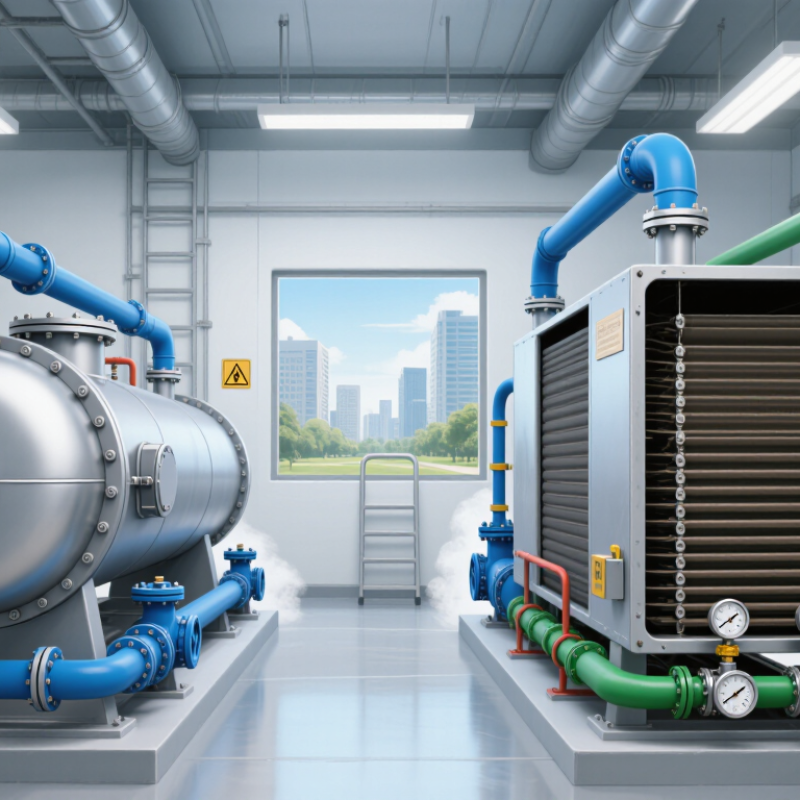
Choosing an evaporator starts with the water circuit, not the catalog size. Shell-and-tube designs suit demanding industrial service and variable water quality. Their tubes can be mechanically cleaned after fouling appears. They also tolerate some operating abuse, but require more space and water volume. Brazed-plate evaporators are compact, efficient, and usually reduce refrigerant charge. Their narrow passages create higher sensitivity to dirty water and freezing. Cleaning is less convenient when internal scaling develops.
Flooded evaporators keep the refrigerant side filled around the heat-transfer surfaces. This arrangement can deliver strong efficiency at steady, large-capacity loads. It also needs reliable oil return, level control, and careful commissioning. Refrigerant inventory is higher. That matters for operating cost, safety planning, and maintenance procedures. No design wins every application. A plate unit may look perfect on paper, yet poor filtration can shorten its service life. A shell-and-tube unit may seem oversized, but its cleanability can repay that decision.
Tips: Check entering water temperature, flow range, fouling risk, pressure drop, and available maintenance space. Review water analysis before choosing a compact plate design. Ask for performance data at your actual temperatures, not only rated conditions. Leave protection against low flow and freezing. My own selection logic would still be revised after seeing the site, because drawings rarely show dirt, vibration, or rushed maintenance.
Size for a 2–5°F Approach Temperature and 10–20°F Water ΔT
How to Choose a Water Chiller Evaporator?
Size the evaporator around a 2–5°F approach temperature and a 10–20°F water ΔT. The approach is the difference between leaving water temperature and refrigerant evaporating temperature. A smaller approach usually requires more heat-transfer surface. It may also increase cost, footprint, and water-side pressure drop.
The water ΔT is the temperature difference between entering and leaving water. For example, water entering at 55°F and leaving at 45°F has a 10°F ΔT. Use the cooling load, flow rate, and target ΔT together. The basic relationship is Q = m × Cp × ΔT. A higher ΔT can reduce required water flow, but it may create uneven temperatures in sensitive processes. Do not guess.
In field applications, I check design temperatures against actual operating records. A clean evaporator may achieve a 2°F approach, while fouling, poor flow distribution, or air pockets can push it beyond 5°F. That margin matters. A 10–20°F water ΔT is practical, but the best point depends on process stability, pump capacity, and seasonal load changes. Oversizing can reduce velocity and weaken heat transfer. Undersizing may cause low suction temperatures, unstable control, or insufficient cooling during peak demand. A neat spreadsheet can still mislead when real water quality and flow conditions are ignored. Allow room for maintenance, but avoid adding surface without reviewing pressure drop and control response.
How to Choose a Water Chiller Evaporator? - Size for a 2–5°F Approach Temperature and 10–20°F Water ΔT
| Design Case | Cooling Capacity
(TR) | Leaving Water
Temperature (°F) | Water ΔT
(°F) | Entering Water
Temperature (°F) | Required Water Flow
(GPM) | Evaporator Approach
(°F) | Estimated Refrigerant
Saturation Temperature (°F) | Typical Application | Selection Note |
| A | 25 | 42 | 10 | 52 | 60 | 2 | 40 | Comfort cooling with high water circulation | Low water ΔT increases flow and pump requirements. |
| B | 50 | 44 | 10 | 54 | 120 | 3 | 41 | Standard chilled-water air-conditioning | A 3°F approach is a common efficiency-oriented target. |
| C | 100 | 44 | 15 | 59 | 160 | 3 | 41 | Large commercial chilled-water system | Higher ΔT reduces flow compared with a 10°F design. |
| D | 150 | 45 | 15 | 60 | 240 | 4 | 41 | District cooling or process cooling | Confirm allowable pressure drop and control-valve authority. |
| E | 250 | 45 | 20 | 65 | 300 | 5 | 40 | High-capacity process or utility cooling | Low flow per ton; verify heat-transfer area at the selected load. |
| Sizing Item | Design Relationship or Guidance |
| Cooling load | 1 refrigeration ton = 12,000 Btu/h. Select the evaporator for the required net cooling capacity, including the specified operating conditions. |
| Water flow | GPM = 24 × cooling capacity (TR) ÷ water ΔT (°F), based on water at approximately 8.33 lb/gal and 1 Btu/lb·°F specific heat. |
| Evaporator approach | Approach = leaving chilled-water temperature − refrigerant saturation temperature. A 2–5°F range generally represents a balance between heat-transfer surface, compressor lift, efficiency, and cost. |
| Water ΔT selection | A 10°F ΔT is common for many comfort-cooling systems; 15–20°F can reduce design flow and pumping energy when terminal units and controls are suitable. |
| Final evaporator checks | Verify minimum and maximum flow, water-side pressure drop, fouling allowance, freeze protection, fluid concentration, design working pressure, and the manufacturer’s certified capacity at the actual entering and leaving conditions. |
Note: The example values are calculated design points for clean water. Actual refrigerant saturation temperature, capacity, pressure drop, and heat-transfer area depend on refrigerant type, evaporator construction, fouling condition, fluid properties, and the certified selection at the required operating point.
Verify 1–2 m/s Water Velocity, Pressure Drop, and Fouling Control
How to Choose a Water Chiller Evaporator?
Evaporator selection should begin with water velocity, not catalog capacity alone. A practical design target is often 1–2 m/s through the water passages. This range supports reliable heat transfer and helps limit sediment buildup. However, it is not a universal rule. Tube material, water quality, temperature, and the manufacturer’s operating limits still matter.
Check the actual flow rate and internal passage area before approving the evaporator. A quick calculation can reveal an uncomfortable mismatch. If velocity falls below the target, fouling may accumulate in low-flow areas. If it rises too high, erosion, vibration, and noise can become serious concerns. It sounds simple. It is not always simple.
Pressure drop must fit the complete pumping system. Include the evaporator, entering and leaving connections, strainers, valves, and control devices. A small pressure loss on a datasheet can become significant after installation. During commissioning, measure inlet and outlet pressure, flow, and entering water temperature. Field readings may challenge the original selection. That is useful information, not failure.
Fouling control also depends on water treatment and maintenance access. Use suitable filtration, maintain stable water chemistry, and provide a practical cleaning method. Do not rely on velocity alone. I have seen designs meet the velocity target yet foul quickly because debris entered during construction. Leave room for inspection, and question any selection based only on nominal efficiency.